Surprising stat: teams that block distractions and schedule inbox windows finish tasks 40% faster than those who don’t.
This article centers on systems, not grit or talent. We examine focus, planning, execution, energy, environment, and social leverage as repeatable rules that drive reliable output.
Expect practical habits you can use tomorrow to keep steady results across a day and a week. This is for knowledge work, business roles, and hybrid teams in the United States.
Productivity is judged by outcomes and quality, not logged hours. Each upcoming section will turn research-backed tactics—like planning the night before, breaking projects into small steps, scheduled breaks, and acting despite mood—into clear routines.
We draw on leadership coaching and workplace research, including tactics popularized by Dr. Rob Yeung and modern performance writers. Use the checklist format to spot your bottleneck—focus, priorities, procrastination, energy, or collaboration—and apply the matching system.
Quick note: tools help, but rules win. Boundaries, task design, and simple routines produce consistent, highly productive results.
Productivity today is a system, not a personality trait
Top performers build simple rules and environments that convert good plans into finished work.
What “highly productive” actually means in modern work and business
Highly productive people reliably deliver valuable outputs in collaborative, interrupt-driven roles while keeping quality and stamina. This definition fits remote and hybrid settings where knowledge work dominates.
Busy vs. effective: measuring results, not hours
Busy work often looks like immediate replies, back-to-back calls, or long hours. Effective action produces a shipped feature, a completed analysis, or a sent proposal.
Try this: pick 1–3 measurable results per day instead of tracking hours. Use that as your success metric for the week.
Why consistent high performers rely on repeatable habits and environments
From time blocks to inbox rules and simple prioritization, top performers use systems to translate plans into action. They reduce choice fatigue and prevent context switching.
- Self-audit: spot leaks — context switches, inbox pulls, unclear next steps, low-energy afternoons.
- Map each leak to a section ahead: focus, planning, execution, energy, or environment.
- Remember: these are learnable skills you can practice and measure.
| Time Leak | Symptom | Quick Fix |
|---|---|---|
| Context switching | Many open tabs, half-done tasks | Block deep-focus windows |
| Inbox pulls | Constant pings, scattered attention | Schedule email windows |
| Unclear next action | Stalls on projects | Write the next step in your list |
| Low-energy afternoons | Slow tempo, errors | Use short breaks and move |
What makes people productive: the focus system that protects deep work
Protecting blocks of uninterrupted time is the single most reliable way to boost high-value output. Focus systems reduce context switching and keep complex work from stretching across the day.
Why highly productive people don’t multitask and what to do instead
Multitasking costs attention: each switch adds delay and errors. Productive people default to single-tasking for deep work and save small items for short windows.
Inbox boundaries that work in the real world
Use two check windows: a morning window (for example, 9:30–10:00) and an afternoon window (~4:00pm). Close email, Slack, and Teams outside those times unless you are on call.
Set norms: state expected response times in your team profile and add urgent routing for real emergencies.
Distraction shutdown: phone placement, tabs, noise, and attention cues
Shutdown checklist:
- Phone in another room or drawer.
- One browser tab per active task; close extras.
- Noise-canceling headphones or low ambient sound.
- Full-screen app and Do Not Disturb on for the block.
Matching the task to your brain: deep-focus blocks vs. shallow-work windows
Reserve morning deep blocks (60–90 minutes) for strategy, writing, and analysis. Define the finish line before you start and remove triggers.
Batch shallow tasks — status updates, scheduling, quick replies — into 15–30 minute windows measured in minutes. If interrupted, capture the cue on a quick list and use a two-minute recap note to restart.
Example daily flow: morning deep block, midday shallow window for admin, afternoon block for review and coordination. Repeatable rules like these protect attention and produce consistent results over time.
Planning and prioritization systems that turn goals into daily tasks
Set tomorrow up for success by mapping outcomes and the first task before bed. A 15–20 minute night routine cuts morning drift and lowers anxiety.
Planning the night before to reduce anxiety and start faster
Spend 15–20 minutes each evening defining top outcomes for the next day. Prep files, outline the first task, and set a clear start time.
Lists that work: translating intentions into action
Use three linked lists: a capture list for everything, a prioritized daily list with 3 commitments, and a next-actions list with verbs and context.
Goal clarity for the week: using SMART targets to avoid busywork
Choose 1–3 SMART targets for the week: Specific, Measurable, Attainable, Relevant, Time-based. If an item does not move those targets, mark it optional.
Weeding out non-important tasks: meetings, admin, and default yeses
Audit recurring meetings and compress updates into async notes. Cut admin hours by batching and reduce 30-minute sessions to 10-minute stand-ups when possible.
Prioritization heuristics:
- Differentiate urgent vs. important and assign time boxes so a task won’t expand into hours.
- Guard morning deep slots for needle-moving work; batch small tasks into a short admin window.
| Action | When | Benefit |
|---|---|---|
| Night planning (15–20 minutes) | Evening | Faster start, less anxiety |
| Daily prioritized list (3 commitments) | Morning or night | Clear focus, measurable results |
| Next-actions list | Continuous | Easy task execution |
| Meeting audit | Weekly | Less time lost to low-value meetings |
Example weekly-to-daily translation: on Monday set weekly outcomes. Each evening pick tomorrow’s 1–3 needle-movers plus a short admin batch. This keeps the week aligned with results.
Execution habits of highly productive people that prevent procrastination
Practical execution routines remove friction and make starting unavoidable. Procrastination often stems from poor task design, not willpower.
Break big projects into a next action, set a 10–20 minute starter sprint, and commit only to visible momentum — an outline, a draft, or a data pull. This lowers activation energy and turns avoidance into progress.
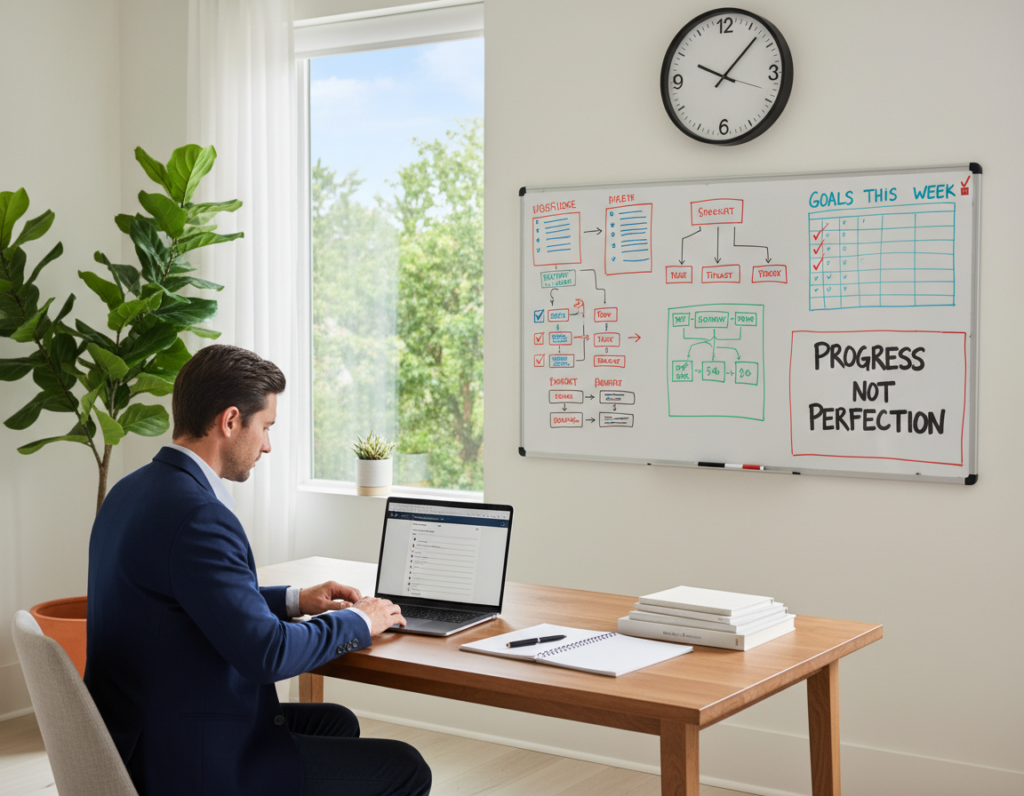
Eat the hardest thing first
Reserve the morning for the toughest, highest-leverage task. Doing the hardest thing early avoids inbox drag and meeting clutter later in the day.
Act despite mood
Dr. Rob Yeung recommends separating feelings from action. Commit to a minimum standard — for example, 25 minutes of focused work — and build from there.
Rewards, shortcuts, and automation
Tie small rewards to completed blocks and larger ones to milestones. Use templates and checklists for recurring deliverables. Apply automation for routing, reminders, and reporting so quality stays high and you save hours.
| Problem | Execution Fix | Result |
|---|---|---|
| Oversized task | Define the next physical action + 15-minute sprint | Starter momentum, less avoidance |
| Low morning focus | Eat the frog in first deep block | High-leverage output early in the day |
| Start friction | Friction audit + shortcut (open file, template) | Immediate start, fewer stalled hours |
| Inconsistent follow-through | Reward tied to process and milestone | Reinforced consistency and habit formation |
Time, breaks, and energy management for consistent high performance
Treat the workday as a sequence of energy investments and planned returns. Frame time and energy as the scarce resources that determine steady output, not nonstop effort. Short recovery rules protect accuracy and speed across the day.
Break design: protecting attention with planned pauses (minutes that pay back)
Schedule intentional breaks. Use a 60/5–10 rule: after each 60-minute focus block, take 5–10 minutes away from the screen. Those minutes repay in fewer errors and faster restart times.
Resting your eyes and reducing cognitive fatigue in screen-heavy jobs
For screen-heavy work, practice distance viewing, hydrate, and blink intentionally during breaks. Move your gaze every 20 minutes and use short walks to reduce fatigue.
Exercise as a productivity tool: mood, stress, and brain function
Short exercise sessions raise mood, lower stress, and support brain function. Even 15 minutes before a deep block improves decision speed and sustained focus.
Eating smart to prevent energy crashes across the day
Follow simple nutrition rules: avoid sugar spikes, prioritize protein and fiber, and plan snacks so you do not skip meals. Eating smart keeps energy steady for top work.
- Energy-based schedule: deep work when energy peaks; admin when energy dips.
- Sustainability: build recovery into the calendar — breaks are required, not optional.
| Issue | Rule | Benefit |
|---|---|---|
| Eye strain | 20/60 gaze + 5–10 min breaks | Less fatigue |
| Afternoon slump | Protein snack + short walk | Stable energy |
| Low focus | 15-min exercise boost | Improved function |
Workplace design: building an environment that makes focus easier
A well-set workplace quietly nudges you into focus rather than relying on willpower. Treat design as default behavior design: the layout and cues around you should make the right action easier than a distraction.
Match the environment to the task type. Deep analytical work needs quiet and privacy. Collaborative planning fits an office or co-working space. Creative drafting can thrive in a coffee shop or a park if the noise is predictable.
Simple experiment to find your best setup
Test two environments across two times of day. Track output quality, speed, and stress for each session. Compare notes after four trials and pick the best-fit setup for repeat use.
Tidy desk, tidy mind
Reduce visual noise. Keep only the materials needed for current tasks within arm’s reach. Prep the next day’s files and tools the night before to cut start-up friction.
Sound strategies that help, not distract
Use steady playlists or ambient noise for low-attention tasks. Choose silence or noise-canceling headphones for high-focus blocks. Match sound to the task to protect concentration and support the mind.
- Signal systems: use a visible “do not interrupt” marker at home or a status light in the office to limit distractions.
- On-screen hygiene: close extra tabs and mute notifications to lower cognitive load.
- Consistent setup: a repeatable workstation reduces decision fatigue and helps you reproduce peak performance across times and places.
Social and leadership systems that multiply your output
High-output teams treat leadership and social systems as multipliers, not accessories. Scale arrives when one person’s focus converts into team capacity through clear roles, norms, and reciprocity.
Delegating wisely to protect high-value work and build team skills
Decision rule: delegate tasks that are lower leverage for you but growth opportunities for others. Define outcome, constraints, and a check-in cadence.
| Task type | Delegate if | Check-in |
|---|---|---|
| Routine reporting | Low value for leader | Weekly sample review |
| Client prep | Good stretch for junior | Draft + 24‑hr feedback |
| Process updates | Training chance | Demo at handover |
Saying no professionally: protecting time while maintaining relationships
Script: “Thanks for asking. My current priorities are X. I can help on Y on [date], or I can connect you with Z.” This preserves relationships and keeps delivery realistic.
Advice, networks, and resilience
Build a small board of mentors and peers. Ask targeted advice, offer help in return, and keep ties active. High performers use networks to solve problems faster and stay deeply socially connected.
Passions, recovery, and failure as feedback
Schedule activities outside of work to protect energy and creativity. Treat failure as feedback: take fast action, run small tests, review, and iterate. This is the practical way to stay effective under pressure.
Conclusion
Close the loop: small, repeatable systems turn plans into measurable results. Focus, planning, execution, energy, environment, and social leverage form the practical framework for steady output.
Quick productivity list: protect deep work, translate goals into daily tasks, start with tiny next steps, manage energy with breaks and movement, and reduce friction in your workspace.
Next 7 days: pick one change per category (focus, planning, execution, energy, environment, leadership) and run it. Track shipped results, not hours, and note which habit raised quality or cut stress.
Refine weekly: keep what works, drop what doesn’t. For a simple start, choose one hard task for tomorrow morning, plan it tonight, set inbox windows, and schedule short breaks.
For extra reading, see the MIT Executive summary on habits that drive higher output.